
What if productivity was built around people from the start?
3 mins to read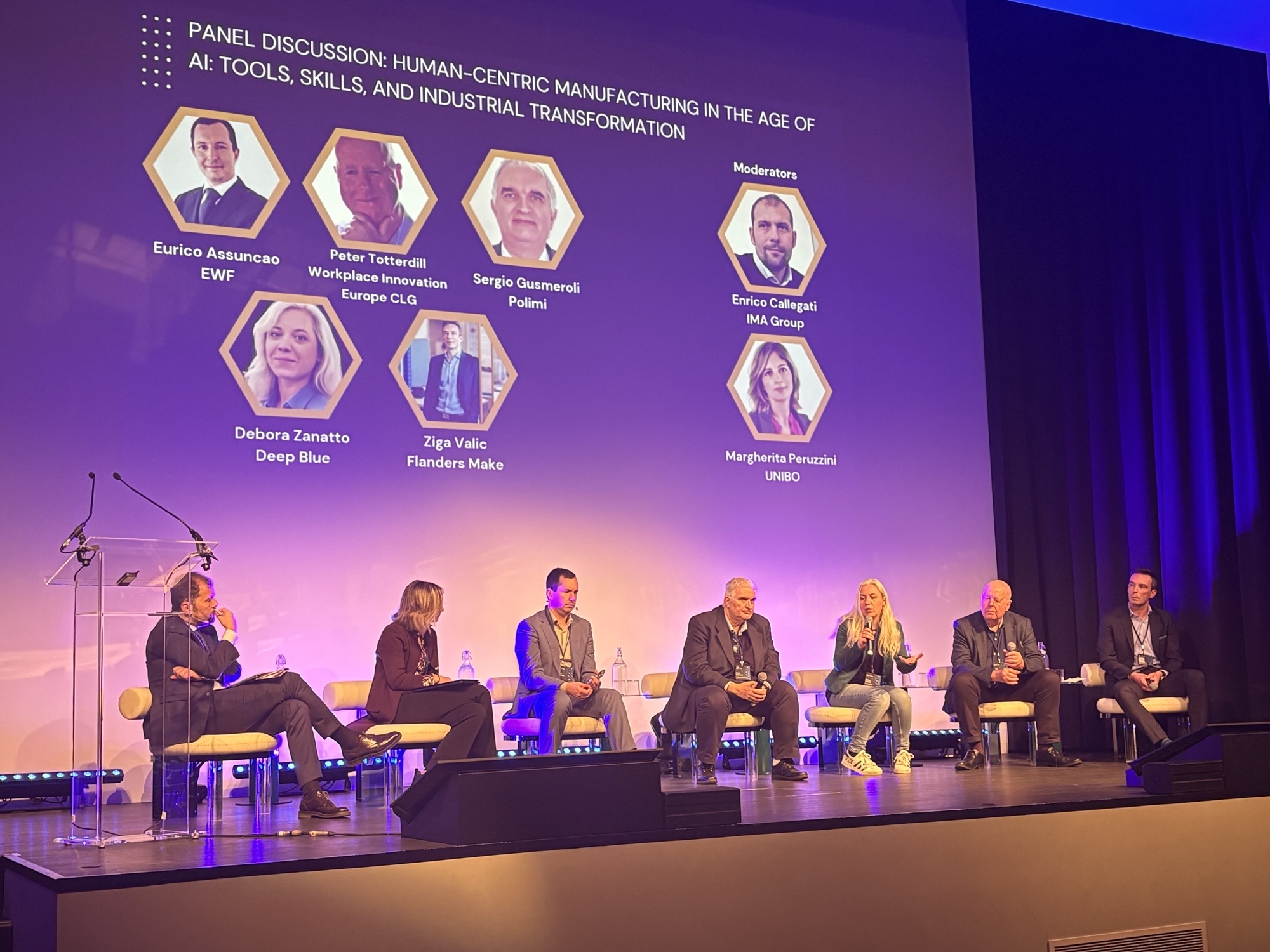
That question sounds almost radical in a manufacturing world obsessed with throughput, automation benchmarks and efficiency ratios. But it was exactly the kind of thinking that filled the room at the recent EFFRA (European Factories of the Future Research Association) event, where COGNIMAN joined the panel, represented by Debora Zanatto from Deep Blue, to tackle one of Europe’s most pressing industrial challenges.
The brief that started the conversation
The session was anchored by the newly released EFFRA R&I Brief, a strategic document that names human-centricity not as a soft value or a policy footnote, but as a core lever for Europe’s industrial competitiveness and resilience. It’s a bold framing. The panel didn’t let it gather dust.
The conversation that followed was anything but a polite roundtable. It cut to the heart of a question that manufacturers, engineers and policymakers have been circling for years without quite landing on: are we designing technology that genuinely works with people or are we retrofitting human tolerance for technology that was never built for them?
Stop treating people as an afterthought
Debora’s contribution to the panel brought the COGNIMAN perspective into sharp focus: human-centric manufacturing is not a layer you add on top. It’s not a corrective measure, a wellness initiative or an ergonomic cushion applied after the machines are already running. It has to be part of the productivity equation itself: baked into the design logic, not bolted on after the fact.
This matters because the alternative (treating people as a variable to manage around technology) produces exactly the kind of brittle adoption that stalls transformation. Workers comply. They don’t commit. And when the first system update breaks their flow or the first data policy crosses a line, the whole thing unravels.
The argument made in the panel was straightforward but consequential: if human value and trust are the foundation of your industrial logic, you can scale that across sectors and technologies. If they’re not, you’re building on sand.
The line between support and surveillance
One of the sharpest moments of the discussion centred on data, specifically on where operational data use tips from helpful into harmful.
Workers, it turns out, are generally open to being supported by data. Wearable ergonomic monitoring? Fine. Real-time feedback on posture or fatigue? Useful. The acceptance is there when the purpose is clear and the benefit is theirs.
But trust collapses fast when that same data gets repurposed. Individual discipline. Hidden profiling. Performance metrics used against the people they were supposedly helping. The moment support becomes surveillance, adoption becomes fragile and no amount of technology investment can recover it.
This isn’t a minor implementation detail. It’s a fundamental design principle. Human-centric manufacturing has to hold that line, not as a regulatory checkbox, but as a commitment embedded in how systems are built and governed from day one.
COGNIMAN as proof of concept
To ground the conversation in something concrete, Debora pointed to what COGNIMAN has made possible and specifically what public funding enabled that market forces alone wouldn’t have produced.
One of the key solutions from the project is the Human-AI Teaming Interaction Model, a framework designed to ensure AI fits human workflows and preserves accountability, rather than the other way around. It’s not a theoretical construct. It’s been applied across the diverse use cases in the project, from additive manufacturing to steel logistics, producing transferable knowledge that travels across industries.
That transferability is the point. Public investment creates the conditions for foundational work that no single company has the incentive to do on its own. COGNIMAN is an example of what happens when that investment is directed with intention, toward frameworks that last, rather than solutions that serve one site and stop there.
The real takeaway: Human agency isn’t the outcome. It’s the starting point!
The panel closed with something harder to quantify than a framework or a data policy: the need for a cultural shift in how leadership thinks about productivity.
Europe has an opportunity to define a new industrial standard, one where human agency isn’t traded away for efficiency, but becomes the engine of it. Where the people on the factory floor aren’t optimised around, but designed for. Where “competitive” and “fair” stop being treated as opposing forces.
That’s not idealism. That’s the argument COGNIMAN went to EFFRA to make. And it landed!